
Drawing Complexity
Drawing politics while social media demands judgment

This page is available in English (UK), Italian
Text and drawing by Gianluca Costantini
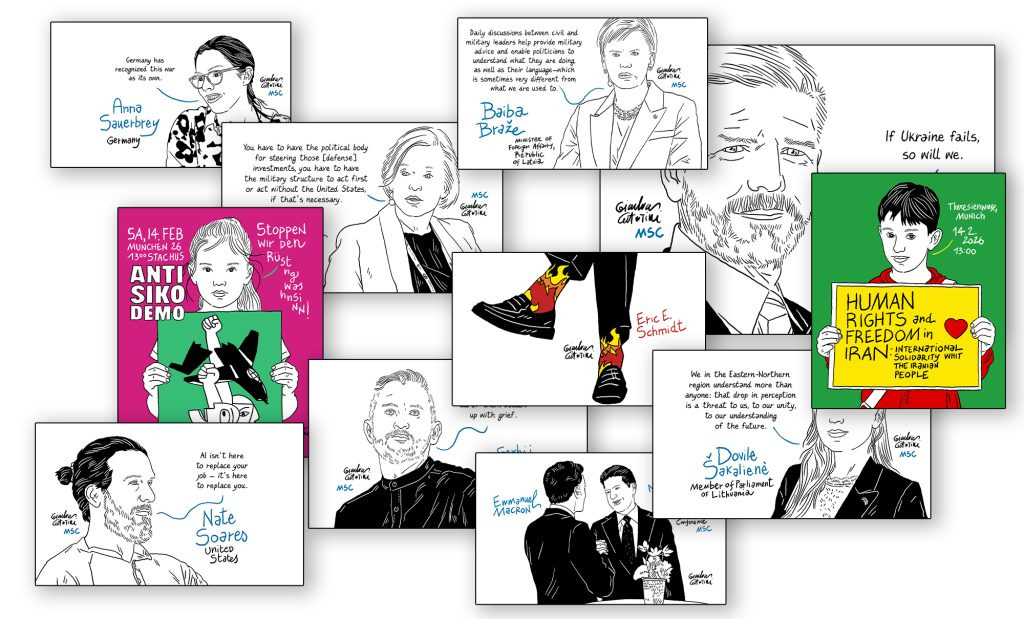
In recent days I followed, through drawing, the Munich Security Conference and several parallel events across the city, including the Munich Peace Conference.
For years I have been using drawing to narrate complex events: human-rights festivals, public demonstrations, institutional meetings, also online. I am interested in staying inside the places where discourses that shape our collective future are produced — and translating them into images.
But something is changing.
There is less and less attention for complex conversations. On social networks, what circulates is mostly what takes a clear, emotional, polarized stance. Those who attend institutional events are often reduced to caricatures: all warmongers, all seeking profit, all pushing rearmament.
Yet reality is not that simple. Inside rigid structures and often harsh language, there are also individuals trying to shift positions, soften formulations, introduce small but meaningful openings. Inside a complicated cage, someone still tries to make a difference.
My drawings are affected by this climate as well.
Illustrations that express a strong opinion get shared. Those that observe — that simply report a moment, visualize a sentence, or reveal a tension — receive far less attention. Narrative is less viral than judgment.
This leads to a broader reflection.
We tend to imagine creativity as impulsive and instinctive, almost opposed to structure. But, as argued in Why Creative Work Depends on Unsexy Systems (by Taylor Scott), creativity does not emerge from chaos — it emerges from organization. Structure is not the enemy of creativity; it is its condition.
Process, method, structure: unglamorous words. Yet they make original thinking possible.
Today this is even clearer. As AI accelerates execution — drafts, notes, summaries, organization — the real value shifts upstream to thinking itself. And thinking requires space. Mental space. Unfragmented time. Systems capable of holding complexity.


If I enter a conference overwhelmed by noise, notifications, and the need to react instantly, I cannot truly observe. If I publish only to chase the algorithm, I am no longer documenting — I am performing.
The same applies to public debate.
Complexity needs infrastructure: places of discussion, transparent processes, clear roles. Without these “boring foundations,” only slogans remain. And slogans do not build the future.
Perhaps the problem is not that people refuse to understand.
Perhaps we have lost the structures that make understanding possible.
Drawing a security conference is not a neutral act, but neither is it automatically ideological. It is an attempt to slow down. To observe. To make nuances visible in a time that rewards only black or white.
Creativity, like democracy, does not grow out of permanent chaos.
It needs systems — even unsexy ones — that protect it.
And maybe today the most radical gesture is not shouting louder,
but staying long enough inside complexity to be able to describe it.
Read also:
Literature as Force and Counterforce: A Czech Dialogue Between Politics and Writing in Munich
Security in an Apocalyptic World: Exploring the Edge Between Fiction and Reality
“Why the US and Europe Are Battling for Greenland’s Future” at MSC Cinema
Stop the Arms Madness! Call Against the NATO Security Conference 2026